


.jpeg)

Is gold safe from sanctions?
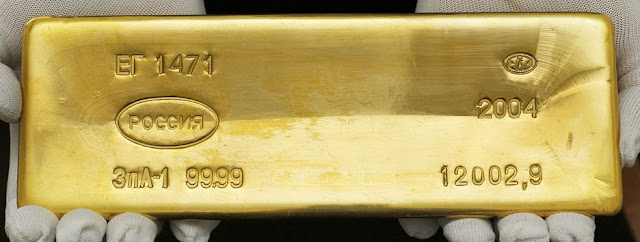
As Russia is progressively cut off from U.S. and European payments systems thanks to an ever tightening wave of sanctions, the idea of using gold as a sanctions buster is being discussed. Russia has some $130 billion worth of the yellow metal. Might these gold bars be packed into planes and used to buy vital goods & services from other countries? To complete this monetary circuit, why doesn't Russia start accepting gold bars as payment for Russian oil and gas exports?
Gold seems like an ideal way to evade sanctions. Thanks to its high value-to-weight ratio, it is good at condensing value. This makes transport easier. Gold is also a bearer instrument. Unlike a dollar, it can't be frozen at the click of a button.
But that doesn't mean that gold can't be stopped by sanctions. Here's how a putative Russian gold payments rail gets shut down.
As of now, the only sanctions that have been announced by the U.S. are primary banking sanctions. That is, the U.S. government has decreed that U.S. financial institutions cannot provide banking services to named Russian banks (like Sberbank), certain individuals (like Putin), and Russia's central bank.
But there is harsher type of sanction that remains to be implemented: secondary sanctions. With secondary sanctions, the U.S. government announces that U.S. banks must cut off not just named Russian entities; they must also stop doing business with any foreign bank (Indian, Chinese, etc) that provides banking services to named Russian entities.
Think of secondary sanctions as a strategy of the friend of my enemy is my enemy. Foreign banks cannot afford to be enemies of the U.S. banking system. That would mean no more access to the massive U.S. economy. And so they will comply and cut off designated Russian entities. Where primary sanctions sever Russian entities from access to the U.S., secondary sanctions attempt to remove them from the global banking system.
To close Russia's gold window, a few additional steps must be taken.
The wording of secondary sanctions must extend to non-banks and into markets like gold. The U.S. might simply say something to the effect that "any foreign individual, corporation, or institution that facilitates gold transactions with designated Russian entities will be shut off from the U.S. banking system." If a foreign buyer of Russian crude oil, say an Indian refiner, had previously accepted Russian gold as payment, they may not be so willing anymore. Touching Russian gold could jeopardize their entire refining business, which will inevitably have a U.S. nexus (say a U.S. parts supplier or technical consultant.)
To enforce sanctions, the U.S. would have to rely on whistle-blowers, snitches, and intelligence gathering. The sanctions would not entirely close the gold window. There would be rule breakers. But the sanctions would do a sufficient job.
The best example of the yellow metal being shut down comes from Iran in the early half of the 2010s.
In 2010, a harsh round of U.S. secondary sanctions came into effect. As these were tightened over the ensuing years, Iranian trade plummeted, as did the Iranian rial. Iran's difficulties were compounded in March 2012 when a set of Iranian banks were banned from SWIFT, a global financial messaging network.
The sanctions did not make it illegal for foreign entities to deal with Iran using gold. And so a gold window emerged. This was most apparent in Turkey with the so-called "gold-for-gas" market. (I wrote about this market here and here). In brief, Turkey relies on Iranian natural gas. A quid pro quo was achieved between the two nations by sending gold bars back to Iran. No need for U.S. dollar correspondent banking accounts. No need for SWIFT.
In July 2012, the U.S. began to close the gold loophole. First it issued an executive order extending sanctions to sales of gold to Iranian Government entities (EO 13622). It was still possible for Turkish institutions to sell gold to Iranian individuals, however, so in January 2013 additional legislation was passed sanctioning the sale of gold to any Iranian entity. (See Benjamin Fraser Scott's Halkbank and OFAC: a sanctions evasion case study for an account of the closure of Iran's gold-for-gas trade.)
And thus Iran's gold loophole was cutoff.
Russia's gold hasn't been sanctioned yet. But it is eminently sanctionable.
PS: Yes, this applies to bitcoin. (Bitcoin is traceable, which makes it arguably worse than gold.)
PPS: Sanctions could put an end to a nascent Russian gold payments rail. But just because sanctions can do damage doesn't mean that the target will change its course of action.