


.jpeg)

Are U.S. banks more competitive than Canadian banks?
Over the years I've had a lot of connections to the Bank of Montreal. I'm a disgruntled ex-customer, a fairly happy shareholder, and a former employee. I stopped being a customer after the Bank of Montreal began charging me monthly fees in the middle of the pandemic without telling me, and I didn't notice for over a year. They refused to refund the fees, so I walked.
In any case, given my multiple interactions with the Bank of Montreal, I try to keep tabs on what it is doing. I was glancing through the bank's 2022 annual financial statement and stumbled on the following notable table:
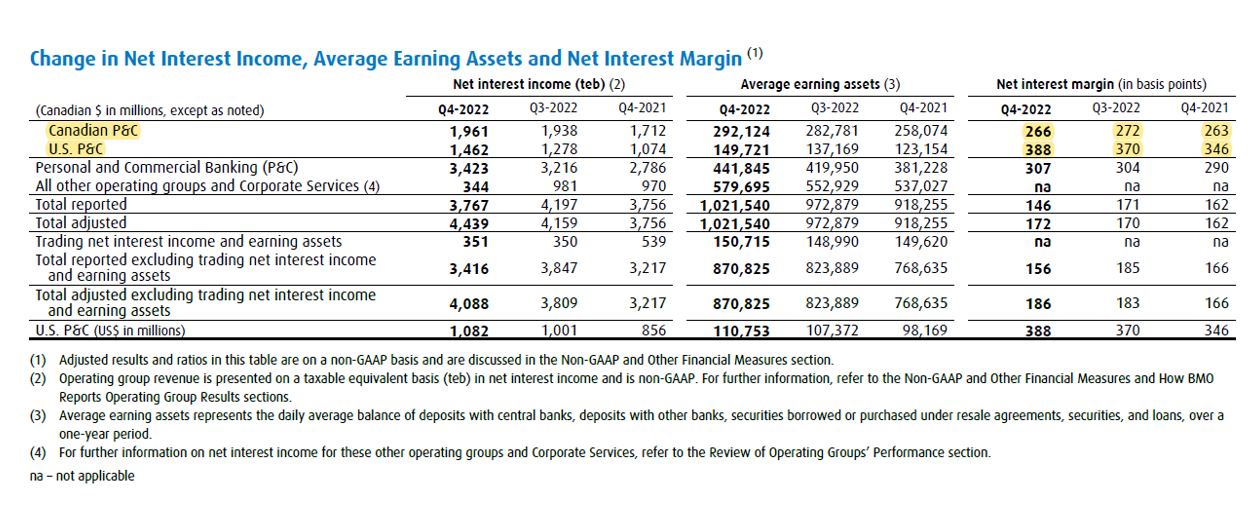 |
| Source: BMO. P&C refers to personal & commercial banking |
The bits that struck me are in yellow. Bank of Montreal's net interest margin is much higher in the U.S. than Canada. By way of background, Bank of Montreal is fairly unique in that it operates as a sizable commercial bank on both sides of the U.S.-Canada border. So its data, including its margins, provides some interesting insights into the fundamental differences between U.S. and Canadian banking.
Net interest margin is a measure of how much a bank is squeezing out of its customers. To calculate it, start by counting up how much money a bank makes in interest on its loans. Then subtract from that its interest costs: all the money it pays out to depositors in the form of interest. That difference is the bank's net interest. Divide net interest by all of the money it makes on its loans to get net interest margin.
Banks want higher margins. Their customers don't. The higher the net interest margin, after all, the more interest the bank is extracting from its customers.
In Bank of Montreal's case, its margin in the fourth quarter is 3.88% in the U.S. and 2.66% in Canada. So for every $100 it lent, the bank collected net interest of $3.88 in the U.S. but just $2.66 north of the border. In short, Bank of Montreal was much better at squeezing Americans than Canadians in 2022. That difference in margins doesn't sound like much, but repeated over billions of dollars it comes to quite a gap.
This isn't a fleeting phenomenon. I glanced over the last 10-years of Bank of Montreal financial data, and its U.S. net interest margin has been consistently superior to its Canadian margin over that entire period.
This goes against my long-standing stereotype of Canadian vs U.S. banking, which goes a bit like this:
I've always thought that it was better to be a U.S. banking customer than a Canadian one. Canada once had a fairly vibrant banking sector, but after many waves of mergers and acquisitions it has consolidated to the point that we've really only got five big bank. Everyone refers to them as an oligopoly. Everyone. I recall that even the Bank of Montreal's in-house bank equity analyst routinely referred to Canada's big 5 as an oligopoly in his research reports.
To make matters worse, Canada prevents foreign competitors from entering and stirring up the pot.
But America is huge and thus capable of supporting a much richer range of banks. For instance, the big 5 Canadian banks hold assets equal to 2.5 times Canada’s gross domestic product, but the assets of the five largest U.S. banks amount to just 0.4 times of that country’s GDP. See the chart below:
This chart from @jason_kirby really gives a feel for how much more concentrated Canadian banking is relative to the U.S.
— John Paul Koning (@jp_koning) April 28, 2022
via https://t.co/L4cosgydaN pic.twitter.com/A872GimuI3
This lack of concentration means that U.S. banks don't have the same oligopolistic stranglehold over Americans that Canadian banks do.
On top of that, U.S. commercial culture is more cutthroat than Canada. Whereas foreign banks are locked out of Canada, they can freely enter the U.S. market. And so I saw the U.S. as an arena for ferocious bank competition, with customers benefiting in the form of better services and higher interest rates. Meanwhile, we Canadians are getting stiffed by our banks.
But after looking Bank of Montreal's net interest margins, I'm not so sure about my stereotype. A lower net interest margin in Canada means that the bank is extracting a smaller pound of flesh from its Canadian customers, which suggests more banking competition up here, not less.
Incidentally, net interest margin doesn't include those pesky user fees we all hate, or what Bank of Montreal calls non-interest revenue. And we know that the Bank of Montreal ruthlessly skins its customers for fees; after all, that's why I closed my account. However, even after adding Bank of Montreal's non-interest revenues to its net interest income on both sides of the border, its Canadian banking business still only sports a margin of 3.5% in fiscal year 2022 compared to 4.5% for its American business.
That is, even after accounting for pesky user fees, Bank of Montreal is still gouging its American customers more than it gouges its Canadian ones.
Admittedly, Bank of Montreal provides just a single data point. So I cast around for more data, and stumbled upon a database called Bankscope, hosted on the Federal Reserve's FRED. Bankscope is a popular source of bank balance sheet information among banking economists.
Here is what U.S. and Canadian net interest margins from Bankscope look like:
 |
| Chart source: FRED |
It confirms my Bank of Montreal anecdote. Going back to 2000, banking net interest margins in the U.S. have been consistently higher than in Canada, and by quite a large amount.
To sum up, given the preceding data I may have to revamp my conceptions of Canadian and U.S. banking. It's true that we have an incredibly concentrated banking sector up here in Canada, with the big 5 controlling an outsized chunk of the market. Paradoxically, this "oligopoly" doesn't translate into higher net interest margins for Canadian banks. Margins are actually more elevated in the the hotbed of capitalism, the U.S., even though its banks are far more diffused. This margin difference suggests that competition among banks is more strident north of the border than south of it.
In short, although the bastards at the Bank of Montreal skinned me for a bunch of fees during the pandemic, the bigger picture is that it's better to be a customer of a Canadian bank than a U.S. one.